
Elevating .NET Development: AI-Powered Test-Driven Development

Software development has evolved significantly over the last decades. One of the most robust methodologies for ensuring code quality is Test-Driven Development (TDD). In the .NET ecosystem, this technique is widely adopted for its clear benefits in software quality, maintainability and early bug detection. However, with the recent integration of artificial intelligence (AI) tools into development processes, TDD has begun to morph into something even more powerful: AI-Powered Test-Driven Development.
This article explores how AI is changing the approach to test-driven development, how these technologies are integrated into the .NET workflow, and the benefits of this combination.
What is Test-Driven Development (TDD)?
TDD is a development technique where unit tests are written before production code is written. The typical TDD cycle includes three stages:
- Net (Fail): Writing a test that will fail, as the code necessary for it to pass does not yet exist.
- Green (Pass): Write the minimum code to make the test pass.
- Refactor (Refactoring): Refactor the code to improve it, ensuring that all tests still pass.
This cycle is repeated for each new feature, resulting in a robust set of unit tests and high quality code.
How does AI improve TDD?
The use of artificial intelligence has allowed TDD to evolve to a higher level. It reduces the developer’s manual workload and speeds up the testing process.
Here are some of the ways in which AI impacts test-driven development:
Automatic generation of unit tests:
One of the biggest challenges of traditional TDD is the need to manually write each unit test, which can be tedious and error-prone. AI tools like GitHub Copilot and Microsoft IntelliCode have revolutionised this process by automatically generating unit tests based on the code the developer is writing.
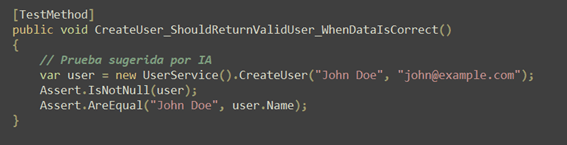
Example: In a .NET project, a developer may be implementing functionality to manage users. AI tools can analyse the code and automatically suggest relevant unit tests, such as:
Improved code coverage:
Often, developers write tests that cover the most obvious cases. But AI-powered tools can identify edge cases or conditions that the developer might have missed. These tools can suggest additional tests that ensure more complete code coverage.
For example, if the developer has written a function to validate email addresses, an AI tool might suggest:
- Test invalid entries such as addresses with special characters.
- Validate emails that use different domains.
- Test extremely long or short emails.
Predictive failure analysis:
AI can also help predict potential bugs in code based on past development patterns or by analysing large databases of common bugs in similar code. For example, if the system identifies that a certain coding pattern is often associated with concurrency bugs, it can suggest tests that validate the behaviour under concurrency conditions.
In .NET projects that use threads or async/await, this capability is extremely valuable. Tools such as SonarQube, based on AI analysis, can detect these patterns and suggest tests to detect possible concurrency errors.
Continuous Improvement Through AI-Assisted Refactoring:
One of the critical steps in TDD is refactoring. AI can assist in this process by suggesting automatic code improvements, keeping all tests green. AI-powered tools can suggest safe refactorings, such as simplifying complex expressions, improving the use of design patterns or eliminating code duplications.
Integration of AI in .NET for TDD
Microsoft has been at the forefront of integrating AI into development tools through platforms such as Visual Studio and Azure DevOps. As a result, it offers .NET developers a number of features that can significantly elevate their TDD workflow.
GitHub Copilot and Visual Studio:
GitHub Copilot, powered by OpenAI, is fully integrated with Visual Studio. It allows .NET developers to receive real-time code hints and unit tests while writing their code. This integration provides test suggestions based on the context and behaviour of the code.
Example of use in .NET:
When a developer starts writing a new class in C#, Copilot can automatically suggest associated tests based on the pattern they are writing. This not only reduces the time needed to create tests, but also ensures that the tests cover a variety of scenarios.
Azure DevOps and Automated Testing:
Azure DevOps can be integrated with AI-powered tools to run code analysis and suggest automatic optimisations based on test performance. With this platform, developers can create CI/CD pipelines where automatically generated tests are run every time code changes are made.
This allows errors to be detected more quickly, improving the feedback loop between development and deployment.
Advantages of AI-Driven TDD in .NET
- Faster development speed: AI-powered automatic test generation and code hinting saves time and reduces the manual burden on developers.
- More complete test coverage: AI helps identify edge cases and complex scenarios that developers may not initially consider.
- High code quality: With AI-assisted refactoring and predictive error analysis, code is guaranteed to be optimised and less prone to bugs.
- Early bug detection: AI tools can identify and suggest tests to detect problems before code reaches production.
- Fewer human errors: By automating key processes in TDD, developers are less likely to make mistakes by manually writing unit tests.
Conclusion
AI-Powered Test-Driven Development in the .NET ecosystem is transforming the way developers approach software quality. It is therefore clear that by combining the robust TDD methodology with advanced AI tools, developers can accelerate development, improve code quality and reduce the risk of bugs.